The European Lunar Push: What EU Space Startups Are Actually Building
ESA's Argonaut and Moonlight programmes, European smallsat suppliers, and the missions now flying to the Moon.
Argonaut: Europe's lunar cargo lander
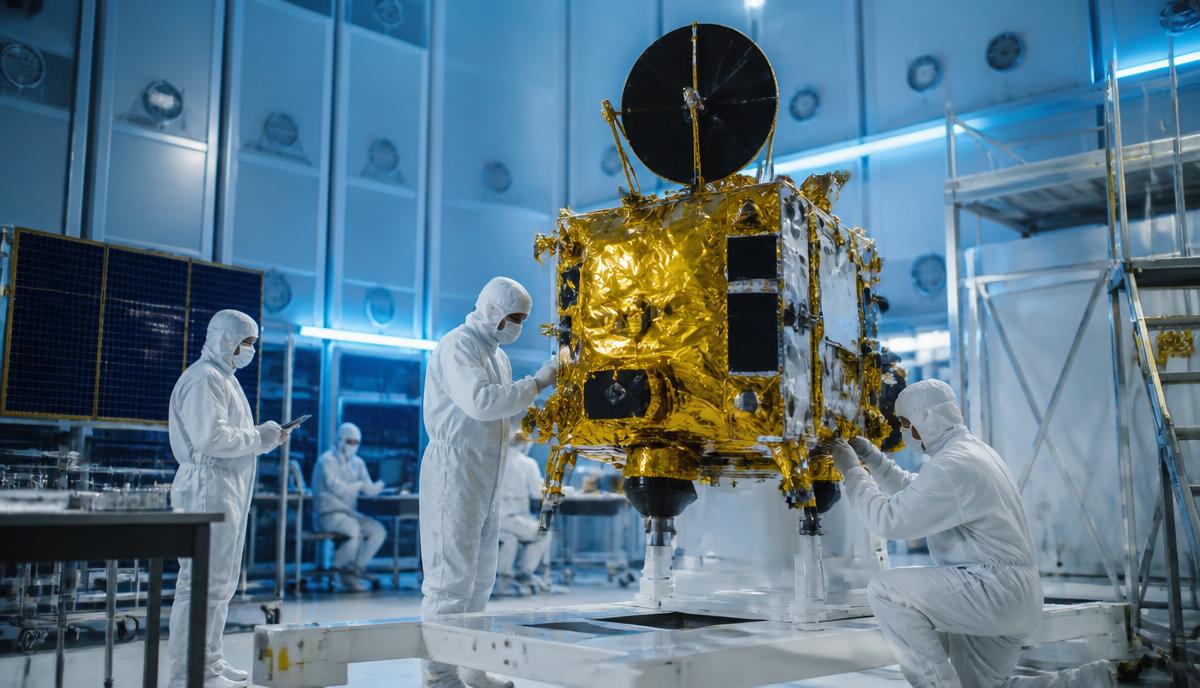
Europe is building a lunar logistics chain. It is not as visible as Artemis, but it is becoming real. The centre of that effort is ESA's Argonaut programme, the agency's plan for a European large logistics lander. On 30 January 2025, ESA signed the contract for the Argonaut Lunar Descent Element with Thales Alenia Space leading the industrial consortium. The full consortium was presented publicly on 20 November 2025. First flight is targeted for the 2030s, with a cargo capacity of up to 1,500 kilograms to the lunar surface on Ariane 6.
Moonlight: communications and navigation
Argonaut is the heavy end. The communications and navigation layer is Moonlight. On 15 October 2024 at the International Astronautical Congress in Milan, ESA signed a 123 million euro contract with a Telespazio-led consortium for the Moonlight Lunar Communications and Navigation Services programme. The goal is a constellation of lunar satellites providing comms and positioning for surface assets. ESA frames it as infrastructure for more than 400 planned lunar missions over the next two decades.
PROSPECT and lunar resource science
The science side is represented by PROSPECT, a drill and analytical laboratory originally developed by ESA for Russia's Luna-27 mission. That partnership ended after Russia's 2022 invasion of Ukraine. PROSPECT has since been re-manifested to fly on a NASA CLPS lander, CP22, targeted for the lunar south pole in late 2026. The ProSEED drill can collect two icy samples per operation, up to 45 millimetres deep and 8 cubic centimetres in volume.
Funding for this period was set at the ESA Ministerial Council in Bremen on 26 and 27 November 2025. Member states pledged 22.3 billion euros, the largest contributions in the agency's history, covering the 2026–2028 budget cycle. The exact allocation to Argonaut, Moonlight and the Terrae Novae exploration strategy will emerge from programme slides, but the overall direction is clear: Europe intends to be a lunar player, not just a subcontractor.
European companies and small spacecraft
Private European companies are moving too. ispace-EUROPE, based in Luxembourg, built the TENACIOUS micro-rover that flew on the RESILIENCE lander launched on 15 January 2025. On 8 January 2025, Luxembourg granted ispace-EUROPE the first-ever mission authorisation under its 2017 Space Resources Law, covering TENACIOUS operations on the lunar surface. ESA described it as the first European rover on the Moon.
Smaller spacecraft are also part of the story. LUMIO, a 12U CubeSat led by Politecnico di Milano with Leonardo and other European partners, is designed to operate in an Earth-Moon L2 halo orbit and detect meteoroid impact flashes on the lunar far side. Its Phase C detailed design kicked off on 2 March 2026 under ESA's General Support Technology Programme. ArgoMoon, built by Argotec in Italy, flew on NASA's Artemis I in November 2022 and returned images of the Space Launch System's interim cryogenic propulsion stage after separation.
Europe's deep-space CubeSat credentials extend beyond the Moon. Juventas and Milani, ESA's first deep-space CubeSats, launched on the Hera asteroid mission on 7 October 2024. They are not lunar, but they prove that European small satellites can operate far from Earth. On 28 October 2024 both spacecraft sent their first signals from deep space.
The barrier to entry has shifted. Rideshare launches, commercial ground stations and standardised subsystems mean a small team can now build a lunar-capable spacecraft in years rather than decades. The remaining gap is not launch access. It is mission-specific knowledge: navigation in cislunar space, operations in extreme thermal environments, and the ability to turn a successful technology demonstration into a recurring service.
That is where SpaceOro fits. The RedTransporter concept is a European take on reusable lunar transport. The previous article explained why a moonbase needs a map before it needs a building. The next looks at what happens once ice is found: turning lunar water into fuel, air and water through ISRU.